
Let’s be honest—none of us writes perfect code all the time. Not even me. And that’s okay. There are often multiple ways to solve the same problem, and even the best developers miss things from time to time. That’s exactly why code reviews are so valuable—especially when you’re early in your software engineering career.
Here’s something I’ve learned from experience and say often:
No one writes perfect code. If someone reviews your code and offers suggestions—especially around standards—be open and welcoming. It will make you a better developer.
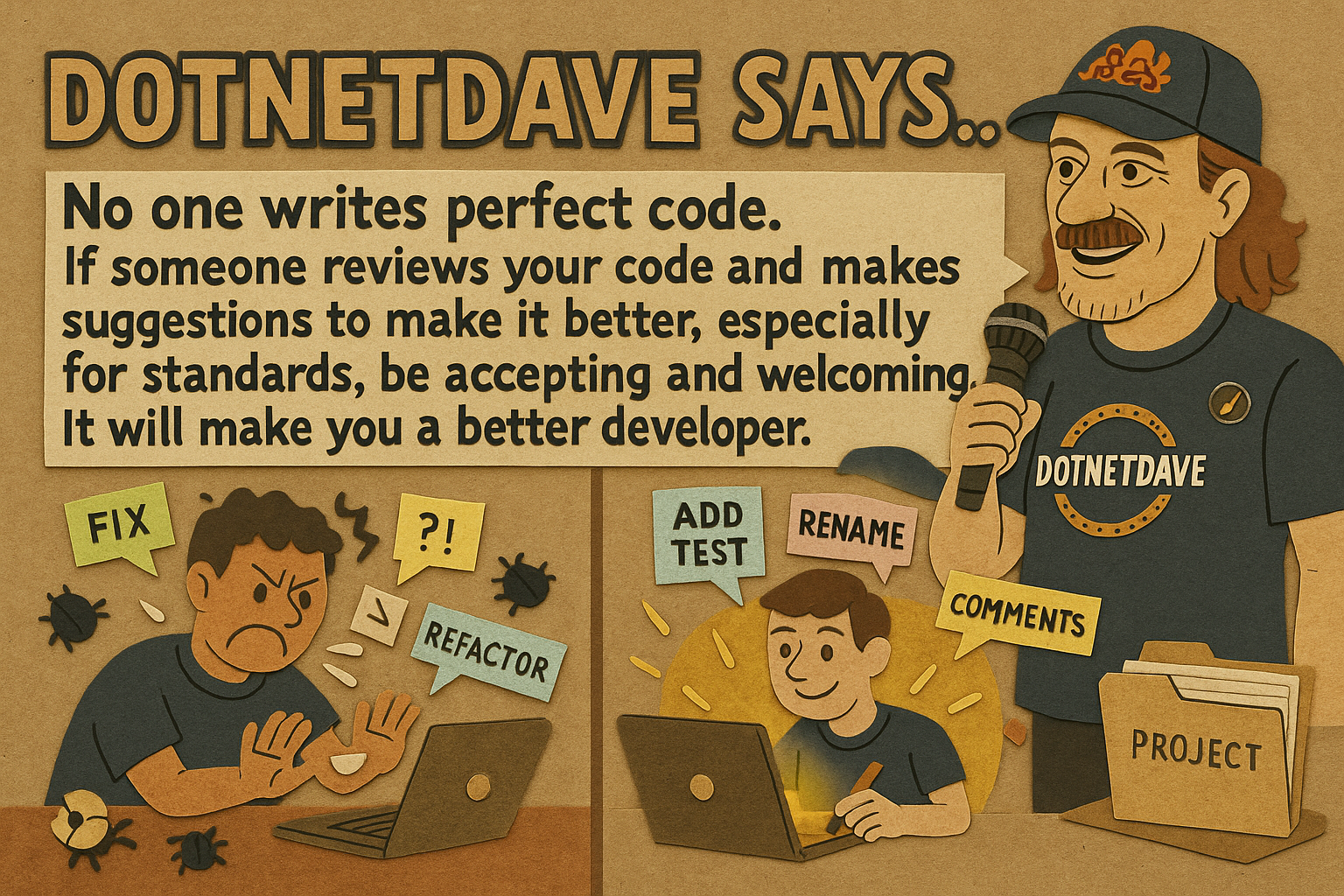
This mindset didn’t come from theory. It came from real-world projects.
In many of my contract roles, I’ve been brought in as a .NET and code quality expert (and yes, I’m the guy who literally wrote the book on .NET coding standards). One of the first things I do when joining a project is review the existing codebase. And every time, I find opportunities for improvement—particularly around memory management, such as failing to properly dispose of disposable objects. Left unchecked, issues like these can—and will—bring down applications and services.
When I provide feedback, whether through code comments or direct conversations with the team, the goal is always the same: make the software stronger.
On one project, a manager asked me to investigate recurring issues. My recommendations were straightforward:
- Address all ASP.NET security violations.
- Avoid using
==to check for empty strings. - Always close standard I/O streams.
- Ensure database connections are closed in a
finallyblock.
These aren’t nitpicks. They’re best practices that lead to safer, more reliable, and more maintainable software. Most managers appreciate this kind of insight. However, team culture can sometimes get in the way.
At one company, developers viewed feedback as personal criticism instead of an opportunity to improve. Despite my efforts to be respectful and constructive, the resistance was so strong that I left the project after just three months.
That experience reinforced an important lesson: most of us were never taught how to give or receive code reviews effectively.
We care deeply about our work, so it’s easy to take feedback personally. But a code review isn’t about you—it’s about helping the code reach its full potential.
Impostor syndrome often plays a role here. Many developers struggle with it—myself included. Ironically, one of the best ways to build confidence is to welcome feedback. Over time, you’ll stop seeing reviews as critiques and start seeing them as conversations—collaborative discussions that help everyone improve.
Of course, no team is perfect. Occasionally, someone will misuse code reviews to criticize others harshly or assert dominance. That behavior is unproductive and has no place in a healthy engineering culture. Strong teams support one another, learn together, and focus on outcomes—not egos.
So the next time your code is reviewed, take it as a compliment. Someone is investing time to help you level up. Ask questions. Stay open. Be grateful for the opportunity to grow.
As professional software engineers, our mission is to build better, safer, and more maintainable software—and that starts with being willing to improve, one line at a time.
Summary
No one writes perfect code—and that’s not the goal. The real value lies in learning, collaborating, and growing through feedback. Embrace code reviews as opportunities to sharpen your skills, strengthen your team, and write better software together.

Pick up any books by David McCarter by going to Amazon.com: http://bit.ly/RockYourCodeBooks
Make a one-time donation
Make a monthly donation
Make a yearly donation
Choose an amount
Or enter a custom amount
Your contribution is appreciated.
Your contribution is appreciated.
Your contribution is appreciated.
DonateDonate monthlyDonate yearlyIf you liked this article, please buy David a cup of Coffee by going here: https://www.buymeacoffee.com/dotnetdave
© The information in this article is copywritten and cannot be preproduced in any way without express permission from David McCarter.
Discover more from dotNetTips.com
Subscribe to get the latest posts sent to your email.

 dotNetTips.com
I have found many of these things are very much an “it depends” situation, but your list is a reasonable starting point for a beginner. I would certainly add ensuring SOLID and DRY, least access (internal vs. public for example), sealed unless designed for inheritance (which is hard) and a few other things..