
Updated JANUARY 2024
There are various methods to concatenate strings in .NET. The most common approach, often employed by developers, is as follows:
string result = "David" + " " + "McCarter";
Before we delve into the remaining aspects of this section, it’s essential to emphasize that strings in .NET are immutable. Here is the definition of immutability:
In programming, immutability refers to the characteristic of an object or data structure that, once created, cannot be modified or changed. Immutable objects are not subject to alteration after their initial creation. Any operation performed on an immutable object results in the creation of a new object rather than modifying the existing one.
Due to this immutability, combining multiple strings could lead to performance and memory issues. I frequently observe developers employing such practices in their code, even when constructing large SQL queries (which could also pose security concerns).
To assess performance, I have conducted a benchmark by iterating through a string array to concatenate the strings. The following code was used for the report.
var result = string.Empty;

Example #1
string.Concat(this.stringArray);

Example #2
foreach (var item in this._stringArray)
{
    result = string.Join(ControlChars.Space, item);
}

Example #3
foreach (string _stringArray in this._stringArray)
{
    result = result + _stringArray + ControlChars.Space;
}
or
foreach (string _stringArray in this._stringArray)
{
    result += _stringArray + ControlChars.Space;
}
One limitation of using Concat() is that it does not support the addition of a separator.
Benchmark Results
Let’s examine the performance of these three methods for combining strings from a string array with varying word counts.
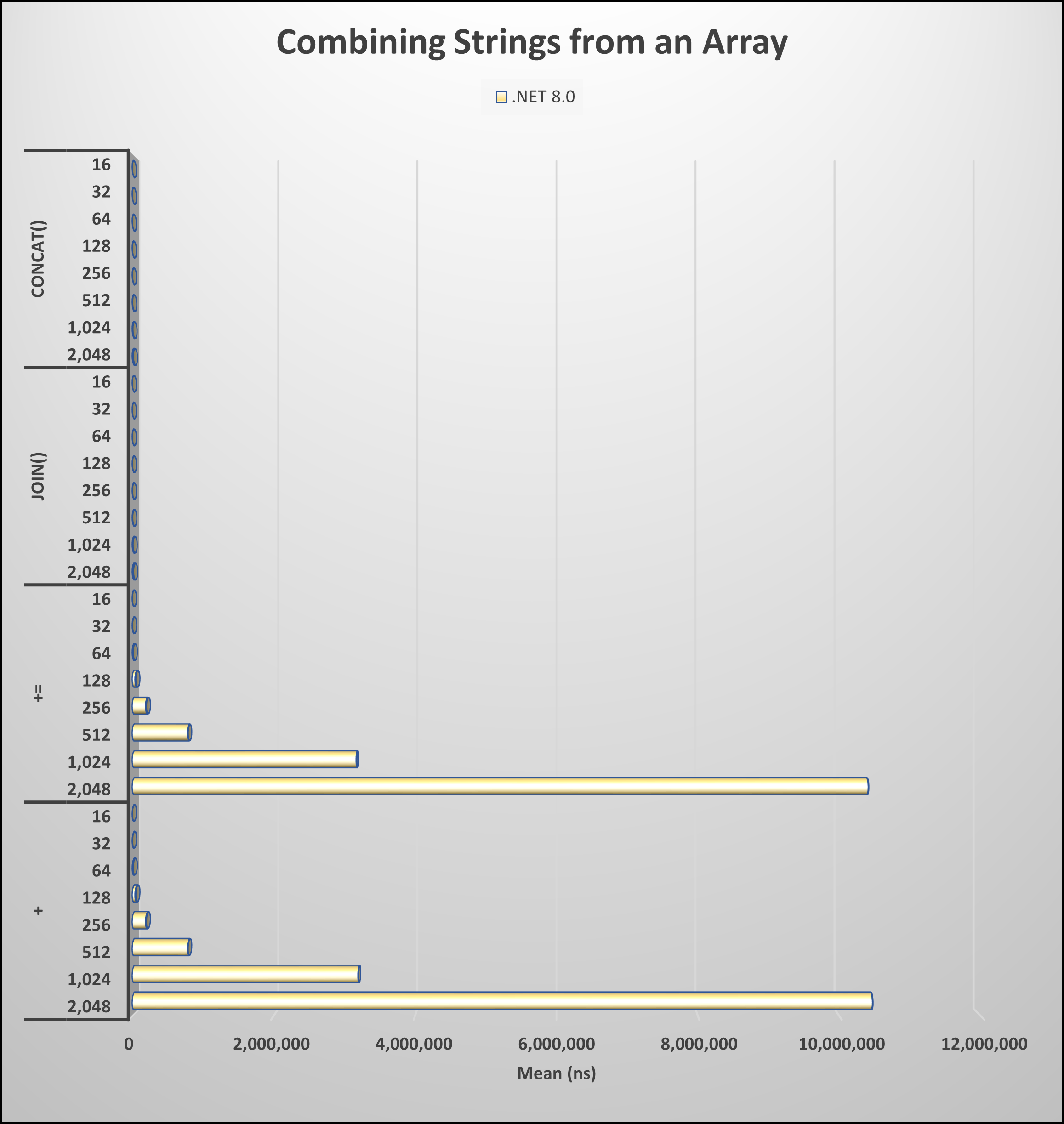
Considering the results, Concat() and Join() stand out as the fastest method when dealing with an array of strings. I strongly advise against using += or + for string concatenation, as it leads to a significant performance decline and larger allocations.
Allocations
There is a substantial difference in the memory allocations observed in these four benchmark tests:
- Concat() & Join(): 504 – 61,464 bytes
- + and +=: 4,736 – 67,190,801 bytes
You can also enhance performance by utilizing StringBuilder!
Pick up any books by David McCarter by going to Amazon.com: http://bit.ly/RockYourCodeBooks
Make a one-time donation
Make a monthly donation
Make a yearly donation
Choose an amount
Or enter a custom amount
Your contribution is appreciated.
Your contribution is appreciated.
Your contribution is appreciated.
DonateDonate monthlyDonate yearlyIf you liked this article, please buy David a cup of Coffee by going here: https://www.buymeacoffee.com/dotnetdave
© The information in this article is copywritten and cannot be preproduced in any way without express permission from David McCarter.
Discover more from dotNetTips.com
Subscribe to get the latest posts sent to your email.

 dotNetTips.com
Curious that you did not benchmark StringBuilder as it is usually the recommended approach for multiple appends/concatentations…..
I did, it’s in a separate post.