Spargine is an open-source library for .NET 8 and 9, featuring assemblies and NuGet packages developed to enhance file path management. It includes PathHelper, which offers extended functionality over the standard Path type, incorporating methods for combining paths, ensuring formatting, and validating inputs.

Tag: Strings
Speeding Up the StringBuilder Using an ObjectPool
Microsoft .NET's ObjectPool type enhances performance by pooling objects, demonstrated in "256 Seconds with dotNetDave." Utilize StringBuilder with ObjectPool by creating the pool as a field, obtaining and returning StringBuilder, and encapsulating calls with try/finally block. Benchmark results show improved efficiency, except for the Insert() method, with different allocation behaviors.
String Performance: Checking for a Substring
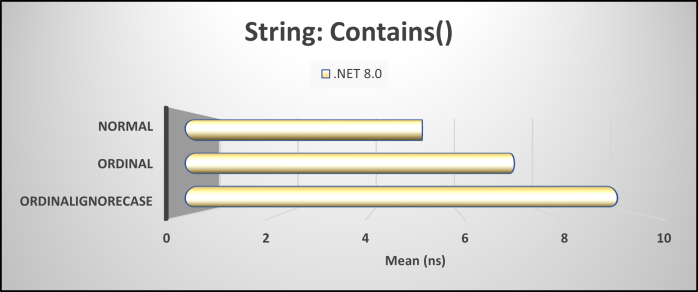
There are three main methods to check for a string, within a string. Those methods, from String, are: Contains(), StartsWith(), and EndsWith(). This article shows the performance differences between these methods. Updated February 2023.
String Performance: Encoding and Decoding Strings
Encoding and decoding strings to and from a byte[] is used a lot in programming. Performance results are for using the formatting options ASCII, Unicode, UTF8, and UTF32, Latin and BigEndianUnicode. Updated February 2023
String Performance: Combining Strings with the StringBuilder
In programming, efficient string concatenation is crucial. Utilizing the StringBuilder class, especially within loops, offers better performance and reduced memory usage. Methods like AppendFormat() and AppendLine() provide formatting and localization benefits. Benchmark results show StringBuilder's significant speed advantage, with minimal memory allocations. Consistently using StringBuilder for string concatenation is recommended.
String Performance: Concatenating Strings
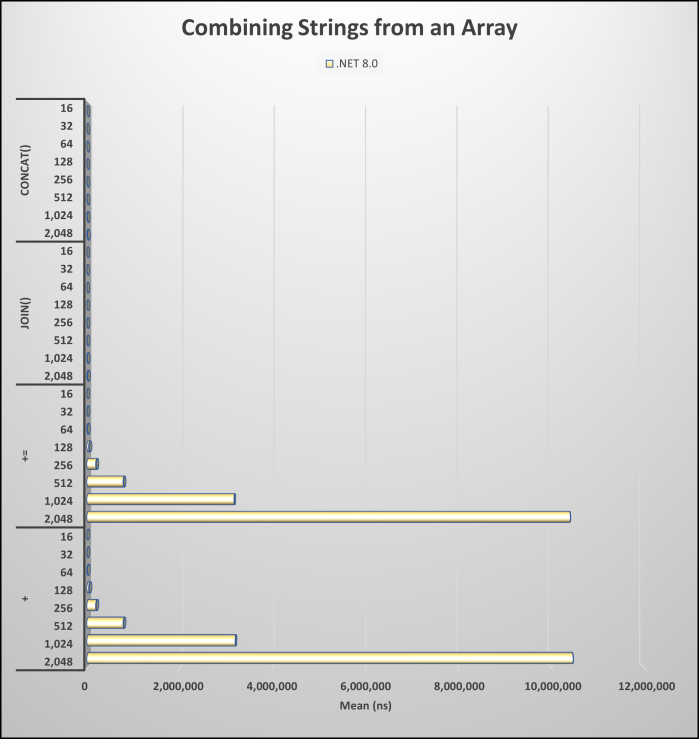
In .NET, string concatenation should be approached carefully due to immutability. Using Concat() or Join() for combining strings from an array is advised for better performance and memory allocation. Avoid using += or + as they lead to significant performance decline and larger memory allocations. StringBuilder can also enhance performance.
String Performance: Formatting
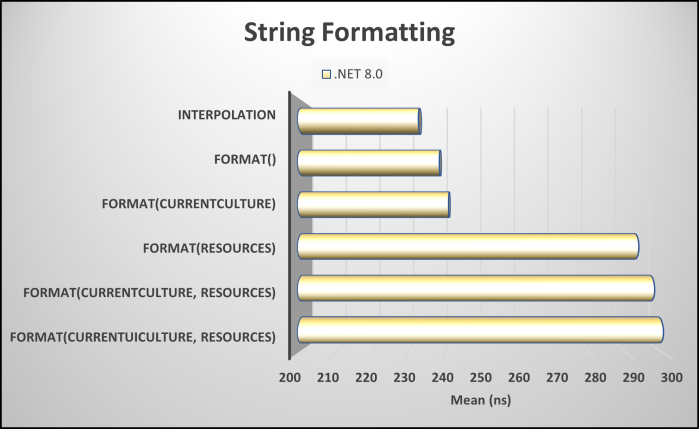
This article discusses the performance differences using string.Format() and interpolation and stresses the importance of using globalization with any string shown to the user. Updated January 2023.
String Performance: The Fastest Way to Get a String’s Length
The article highlights the importance of using efficient methods for checking if a string is empty or null, emphasizing the performance benefits and exception prevention of using `string.IsNullOrEmpty()` and `string.IsNullOrWhiteSpace()` over the traditional `if (emailAddress == "")` approach. Benchmark results reveal that using null and `string.Empty()` is the most performant way to check for an empty string, with other methods showing similar performance levels. Updated January 2024.
String Performance: String Comparison
The article discusses the importance of choosing the right string comparison method in coding, emphasizing the use of ToUpperInvariant() for accurate globalized comparisons, and presents benchmark results showing its performance advantage. It also briefly mentions the comparison between the == operator and Equals() for checking string equality. Updated January 2024.

You must be logged in to post a comment.