
The post explains two methods to confirm if an object is a string. It provides code examples for both methods and states that the first method is 1.17 times more efficient than pattern matching.

The post explains two methods to confirm if an object is a string. It provides code examples for both methods and states that the first method is 1.17 times more efficient than pattern matching.

The article introduces two methods, IsEmpty() and IsNotEmpty(), for validating empty strings in Spargine, comparing them to the IsNullOrEmpty() method in .NET and emphasizing their straightforward usage and ability to handle null checks. Benchmark results reveal that IsEmpty() surpasses IsNullOrEmpty() in performance, exhibiting a 2.92 times faster execution speed.
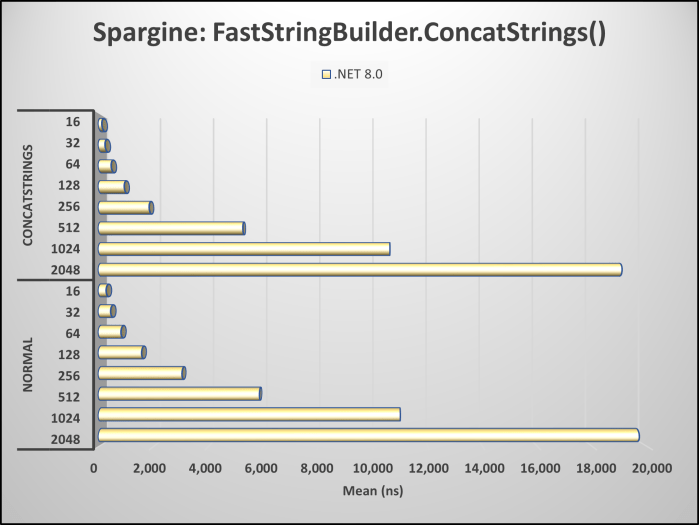
Explore enhanced string concatenation in C# programming with the FastStringBuilder from DotNetTips.Spargine.Core, utilizing the ConcatStrings() method for optimized performance. Benchmark results reveal a 1.107 times performance improvement and reduced memory allocations, making it a valuable tool for efficient string manipulation.
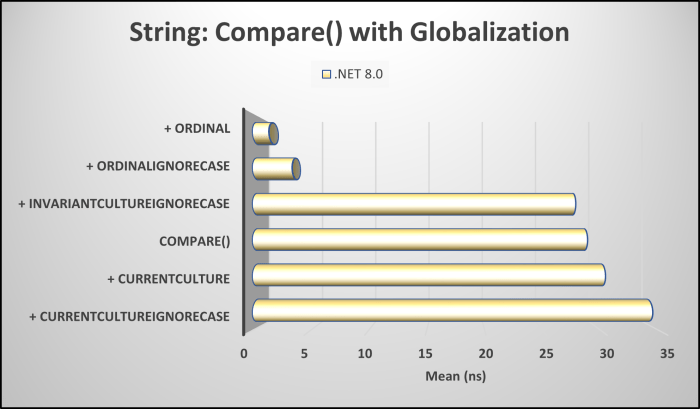
In the String Performance chapter of the code performance book, the author demonstrates the usage of string.Compare() with StringComparison. Benchmark results are provided, along with a recommendation to use cultures or ordinals based on the strings being compared. The chapter also touches on setting up EditorConfig for dotnet_diagnostic.CA1862.

The content discusses the significance of string compression in programming, outlining four available data formats and demonstrating how to compress and decompress strings using Brotli. It also mentions benchmark results and a tool called Spargine for streamlining the process. For more details, visit the provided link and subscribe for access to exclusive content.

The post discusses optimizing string concatenation in .NET by using the Span type, which significantly enhances performance and reduces memory allocation.
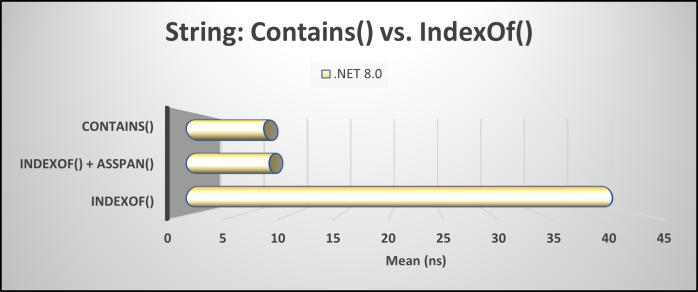
In this article, we explore Microsoft's recommendation to utilize the String.Contains() method instead of String.IndexOf() for improved code readability. We provide code examples to illustrate this suggestion and discuss its relevance in the context of common coding practices, referencing its application in Entity Framework source code and adherence to coding standards like CA2249.

The article suggests using the string.Method(char) approach instead of string.Method(string) for strings containing a single character to improve performance. It highlights an example where this optimization can be applied in the Entity Framework source code and mentions that this deviation from the recommended guideline occurred 34 times in the codebase. The article also references violation codes CA1865 – CA1867 and mentions their severity settings in the .editorConfig file. Update March, 2024.

In this article, the author delves into the intricacies of the Entity Framework codebase, uncovering 168 instances that require optimization to boost performance. Explore the valuable insights and strategies for fine-tuning your Entity Framework application to ensure it operates at its peak efficiency.

Throughout the author's career, the significance of supporting various spoken languages and locales in applications and services is emphasized. The process of globalizing strings using the .NET team's Multilingual App Toolkit and the subsequent translation process using the Azure Translator are detailed, providing efficient and cost-effective solutions for internationalization.
 dotNetTips.com
You must be logged in to post a comment.