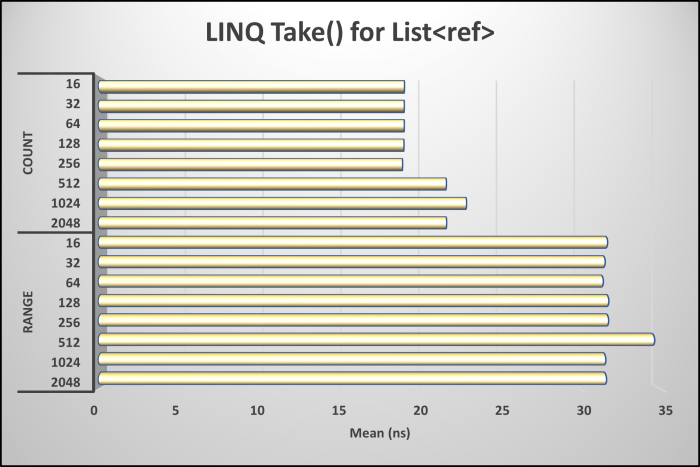
The article advises caution when using the LINQ method Take() with a basic count, suggesting that a range might be recommended by code analyzers. However, benchmark results indicate that using Take() with a simple count is 1.63 times faster than employing a range in such cases.
Tag: Collections
Collection Performance: Looping Over a Collection Using Span and ReadOnlySpan
The article explores the performance benefits of utilizing Span and ReadOnlySpan for collection processing, highlighting advantages such as improved performance, reduced memory pressure, enhanced safety, and compatibility with modern API design. Span allows read-write access and efficient iteration with lightweight storage, while ReadOnlySpan provides read-only access to prevent accidental modifications, offering similar benefits for collection processing.
Collection Performance: Optimizing Sequence Comparison
The article discusses different methods for comparing two collections for identity in programming. It introduces the use of the SequenceEqual() method for comparing sequences in the LINQ extension methods, as well as the StructuralSequenceEqual() method, which is beneficial for comparing custom classes based on the values of their elements rather than object references.
Collection Performance: Leveraging LINQ MAXBy() and MINBy() for Efficient and Readable Code
The article explores the usage of LINQ's MinBy() and MaxBy() methods, which efficiently return the objects with the minimum and maximum values in a sequence based on a specified key selector function.
Optimizing Data Manipulation with LINQ
LINQ is a powerful but potentially performance-hindering feature in .NET, offering a clean syntax for data querying. This content explores its inner workings, highlighting scenarios where it excels and where alternatives are more efficient. The aim is to maximize performance while leveraging LINQ, ensuring effective and rapid .NET code development.
Collection Performance
These articles delves into performance optimization for collections in .NET, covering topics like looping, sorting, and utilizing different types of objects. The author identified performance variations related to the object type in the collection and recommends conducting benchmark tests. All recommendations are specific to .NET 8.
Code It Any Way You Want: Optimizing Span Operations – Clear vs. Fill
This article compares two key search methods in dictionaries: using `Contains()` on the Keys collection and `ContainsKey()` method directly on the dictionary. It demonstrates examples for both approaches, highlighting Microsoft's recommendation of using `ContainsKey()`. The article suggests further examination of the performance aspect of these methods.
Collection Performance: Is LINQ Always the Most Performant Choice?
The article explores the performance implications of using LINQ for collection queries, finding that a conventional foreach() loop outperforms LINQ by 1.75 times in identifying items matching a given query. The conclusion suggests benchmarking to determine the optimal approach based on the nature of the query and elements being sought.
Collection Performance: Creating a List<> Using The Task.Parallel Library
The post discusses alternative approaches to adding items to a collection using For() or ForEach() from the Task Parallel Library.
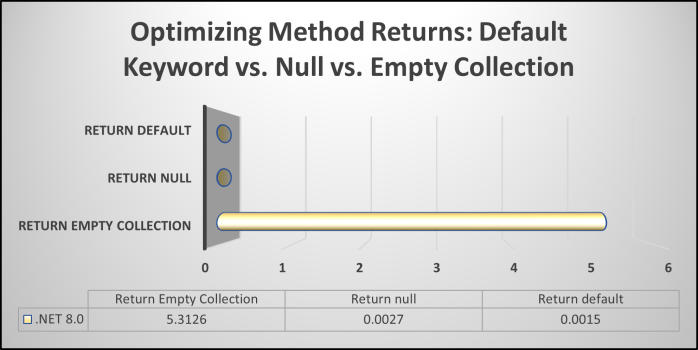
General Performance Tip: Optimizing Method Returns
When customizing attributes, Microsoft and I both advise sealing them for clarity and performance. However, benchmark results show sealing attributes to be marginally less performant, with both outcomes indicating a memory allocation of 24 bytes. Despite this, I maintain that sealing non-inheritable classes is essential for robust class design.

You must be logged in to post a comment.