When customizing attributes, Microsoft and I both advise sealing them for clarity and performance. However, benchmark results show sealing attributes to be marginally less performant, with both outcomes indicating a memory allocation of 24 bytes. Despite this, I maintain that sealing non-inheritable classes is essential for robust class design.
Category: Performance
Collection Performance: Comparing Key Search Methods in Dictionaries
The post discusses two methods for searching a specific key in a Dictionary. The ContainsKey() method is recommended by Microsoft for improved performance but is it more performant?
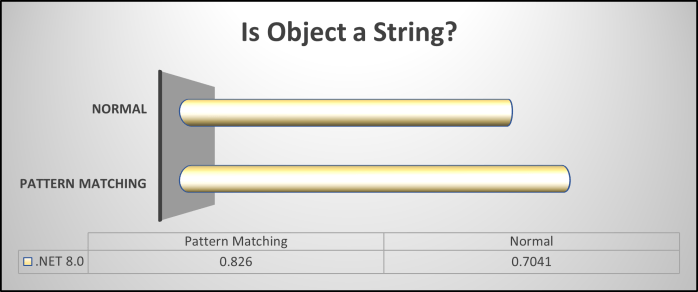
String Performance Tip: Verifying if an Object is a String
The post explains two methods to confirm if an object is a string. It provides code examples for both methods and states that the first method is 1.17 times more efficient than pattern matching.
General Performance Tip: Constant vs Read-Only Property
It is recommended to use constants for static numerical or string values in code. This helps maintain code clarity and adhere to best practices. Benchmark tests show variables are slightly more performant than constants, but it is still advisable to use constants where appropriate to reflect the intent of the variable.
General Performance Tip: Generating Random Numbers
.NET's Random type has been a popular choice for generating random numbers. However, using RandomNumberGenerator for this purpose can result in a six-fold performance improvement, as shown in benchmark tests. Both methods allocate the same amount of memory.
Code It Any Way You Want: Performance of Out Variable Declaration
Starting with .NET 7, it's advised to use inline variable declarations for out parameters, enhancing performance and readability. This approach simplifies refactoring, limits variable scope, and can enable better compiler optimizations. Benchmarks indicate a 1.03x performance improvement, making code more maintainable and easier to understand.
Collection Performance: Using ForEachAsync() with List<>
The post demonstrates the usage of Parallel.ForEachAsync() with a List of reference types.
General Performance Tip: Enhanced Logging Approach
The article discusses advancements in logging techniques in .NET, particularly with the new source generator in .NET 6 that enhances performance using LoggerMessage. This new method improves logging efficiency by 11.25 times compared to previous approaches. It emphasizes the importance of extensive logging for issue resolution in code.
Collection Performance: Comparing Byte Array’s with SequenceEqual()
LINQ's SequenceEqual() method compares two Byte arrays, returning a Boolean indicating equal length and matching elements. Access more on collection performance by subscribing.
General Performance Tip: Retrieving the Process Id
When working with .NET, developers can obtain the initiating process ID using either Process.GetCurrentProcess().Id or System.Environment.ProcessId. Benchmark tests show that the former is slightly more performant. Additionally, the setup for this is specified in EditorConfig as a suggestion for code quality.

You must be logged in to post a comment.