Developers can simplify hashing byte arrays by using HashData() instead of ComputeHash(), as it requires less code and eliminates the need to manage the SHA256 object. Benchmarking shows HashData() is about 1.16x faster than ComputeHash() and 1.02x faster than TryHashData(). EditorConfig helps manage related diagnostics.

Category: Defensive Programming
General Performance Tip: Creating an Object
In this investigation of object creation in .NET, various methods were explored, including "new" keyword, Activator.CreateInstance, and RuntimeHelpers.GetUninitializedObject.
General Performance Tip: Avoid Unnecessary Variable Initialization
In the analysis of code, it's noted that explicit initialization of variables, when the default state is already set, can impact performance. Situations requiring variable initialization are discussed, with examples showing unnecessary explicit initialization. The default values for reference types and the default values for properties of a custom type are also examined.
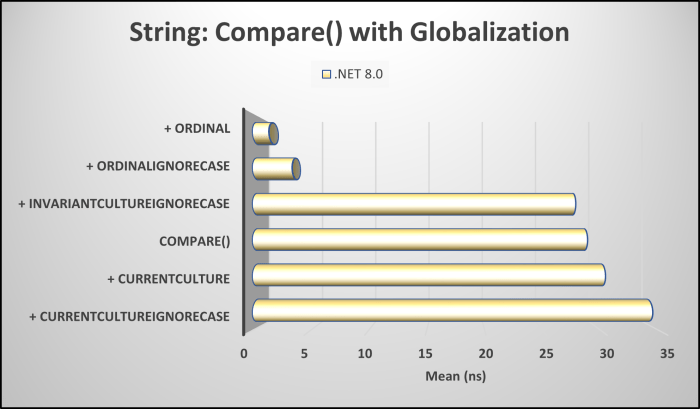
String Performance: Comparing Strings with Globalization
In the String Performance chapter of the code performance book, the author demonstrates the usage of string.Compare() with StringComparison. Benchmark results are provided, along with a recommendation to use cultures or ordinals based on the strings being compared. The chapter also touches on setting up EditorConfig for dotnet_diagnostic.CA1862.
General Performance Tip: Constant vs Variable
It is recommended to use constants for static numerical or string values in code. This helps maintain code clarity and adhere to best practices. Benchmark tests show variables are slightly more performant than constants, but it is still advisable to use constants where appropriate to reflect the intent of the variable.
General Performance Tip: Null Coalescing Assignment
In C# 8, a new method for null coalescing assignments was introduced, simplifying the code. Performance benchmark results show a slight advantage in using the traditional approach for null checking compared to the new method. Previously, the performance difference between the two methods was negligible.
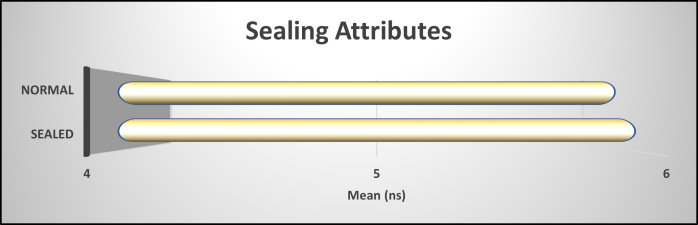
General Performance Tip: Performance Impact of Sealing Attributes
When customizing attributes, Microsoft and I both advise sealing them for clarity and performance. However, benchmark results show sealing attributes to be marginally less performant, with both outcomes indicating a memory allocation of 24 bytes. Despite this, I maintain that sealing non-inheritable classes is essential for robust class design.
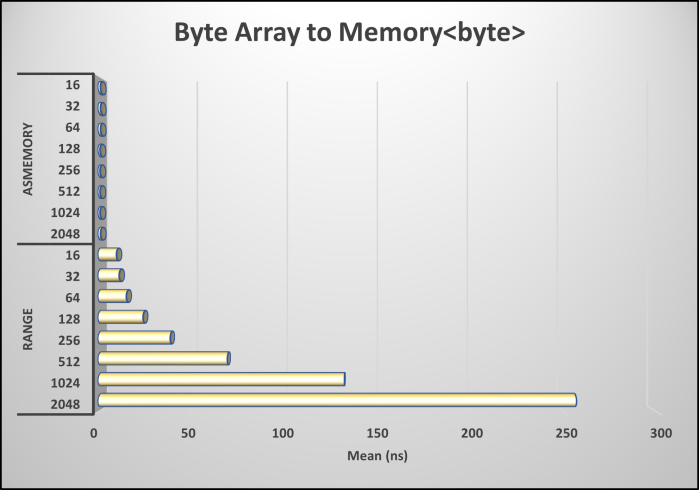
Collection Performance: Memory Efficiency with AsMemory() in Byte Array Conversion
The article discusses the efficiency benefits of using AsMemory() for byte array conversion, emphasizing reduced memory usage, future-proofing code, and performance optimization. Benchmark results highlight a significant performance advantage, with a 54 times improvement compared to other methods, reinforcing the importance of AsMemory() for optimal performance in memory-sensitive applications.
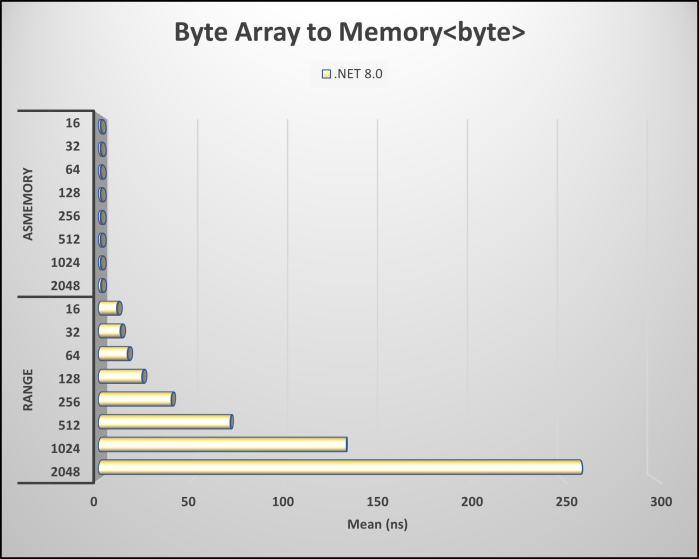
Collection Performance: Converting Byte Array to Memory<> and ReadOnlyMemory<>
When working with byte arrays, there are two methods to convert to Memory. Using AsMemory() offers performance optimization, efficient memory management, improved code clarity, and future-proofing. Benchmark results show a 57x performance improvement, with no memory allocation. This method is crucial for memory-sensitive applications and large datasets. Utilize AsMemory() for optimal performance and efficient array handling.
Collection Performance: Exploring the Performance Impacts of Array Properties
The post critiques developers’ practices of using properties that return arrays, highlighting issues like lack of encapsulation, read-only enforcement challenges, and limited flexibility for future changes. It recommends using methods or collections as alternatives, despite performance benchmarks indicating that array properties are more efficient, ultimately suggesting adherence to Microsoft's guidelines.

You must be logged in to post a comment.