DirectoryHelper, part of the DotNetTips.Spargine project, enhances file and directory I/O operations on Windows by improving performance and preventing errors. Its methods support tasks like copying, deleting, and safely searching for directories and files. Leveraging DirectoryHelper can streamline development and mitigate common file system issues for developers.

Category: Defensive Programming
The Vital Role of QA: Why Independent Testing is Essential for Software Integrity
In the world of real estate, rigorous inspections are essential for a safe and functional home. Similarly, in software development, Quality Assurance (QA) plays a crucial role in testing software for quality, security, and performance. While unit tests are important, they cannot replace the comprehensive testing provided by a dedicated QA team. Collaborative integration of QA from the beginning of a project, effective communication, and comprehensive documentation are essential for robust and reliable software. Quality should be a core feature of any product, requiring dedicated resources and attention to prevent costly failures and protect user trust.
Collection Performance: Enhancing Dictionary Performance with FrozenDictionary
The FrozenDictionary is a thread-safe, immutable, read-only dictionary optimized for fast lookups. It outperforms the Dictionary, reducing iteration and lookup times significantly.
Serializing Objects: Efficient Serialization and Deserialization of Collections with JsonSerializer
The article demonstrates the ease of serializing and deserializing collections using JsonSerializer.
Understanding and Utilizing Common Attributes in Classes in Microsoft .NET
Attributes in .NET provide crucial metadata that enhances code clarity, tooling support, and developer experience. They enforce contracts, improve static analysis, and facilitate safe coding practices. By thoughtfully utilizing attributes like [DisallowNull], [DebuggerDisplay], and [DefaultValue], developers can create expressive, maintainable, and user-friendly APIs that benefit both current and future projects.
Code It Any Way You Want: Initializing Reference Type Static Fields Inline for Enhanced Code Readability
The article advocates for initializing reference type static fields inline to enhance code readability and prevent unexpected behavior caused by uninitialized static fields. Microsoft recommends initializing these fields at the point of declaration to improve clarity. The article provides examples demonstrating the issue and the recommended solution, emphasizing the use of static constructors for initialization.
Code It Any Way You Want: Expression-Bodied Methods vs. Traditional Methods
The article discusses the use of expression-bodied methods in .NET as an alternative to traditional methods for creating simple functions. It presents a comparison between the two methods in terms of syntax and performance. Despite the syntactical differences, benchmark results show that both methods demonstrate similar performance characteristics.
General Performance Tip: Retrieving the Nullable Value from a Reference Type
The article discusses two methods for retrieving nullable values from reference types in C#, showcasing examples using the ternary conditional expression and the null coalesce approach. Benchmark results indicate that the null coalesce approach demonstrates 1.12 times higher efficiency in performance compared to the ternary conditional expression.
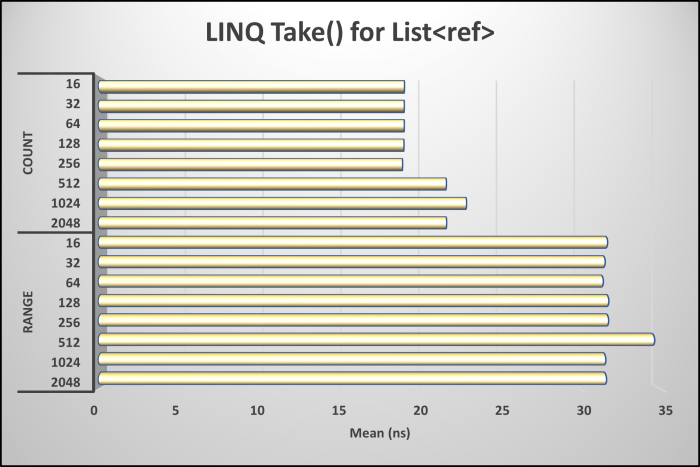
Collection Performance: Exercise Caution When Using Take() with a Basic Count
The article advises caution when using the LINQ method Take() with a basic count, suggesting that a range might be recommended by code analyzers. However, benchmark results indicate that using Take() with a simple count is 1.63 times faster than employing a range in such cases.
Code It Any Way You Want: Performance Difference Between Static and Non-Static Methods
Most code analysis tools advocate for static methods due to perceived performance benefits. However, benchmarks indicate that non-static methods often outperform static ones despite avoiding instance dispatch. It's advisable to choose function types based on team coding standards. EditorConfig settings can help manage these preferences effectively.

You must be logged in to post a comment.