This article explores the critical issue of code quality in software development. The author, with years of experience in advocating for coding standards, shares insights from fellow developers on how to enhance code quality. Key suggestions include emphasizing unit testing, code comments, and better training, while addressing ego-related challenges in code reviews. The article underscores the importance of fostering a culture of quality and incorporating coding standards into education. It highlights the need for a strong commitment to code quality in today's security-focused software landscape. Ultimately, the article offers actionable ideas for improving code quality within development teams.

Category: Coding Standards
Properly Setting Up .NET Core Projects
Visual Studio by default does not set all the appropriate options to help you write rock-solid .NET Core code. Below are the recommendations that your team should use for C# projects. All the following recommendations are for Visual Studio 2019. If you have an older version, most of this should still apply. To learn the … Continue reading Properly Setting Up .NET Core Projects
Properly Setting Up .NET Framework Projects
Visual Studio by default does not set all the appropriate options to help you write rock-solid code. I will show the recommendations that your team should use for C# projects. All the following recommendations are for Visual Studio 2019. If you have an older version, most of this should still apply. More information, including suggestions … Continue reading Properly Setting Up .NET Framework Projects
Properly Comparing Strings with Globalization and Performance in .NET
In Microsoft .NET there are many ways to compare strings. I would say that most of the code I analyze, I see it done one of these two ways: bool result = email1 == email2; bool result = email1.Equals(email2); Is this the best way to compare strings? The quick answer is no. While this works, … Continue reading Properly Comparing Strings with Globalization and Performance in .NET
dotNetDave Says… If Your Code Is Hard To Unit Test, You’re Doing It Wrong!
Unit testing is vital in software projects, yet often neglected. Many developers avoid writing tests, but they provide necessary confidence and enable safe code changes. Without unit tests, deploying code can lead to significant issues. Responsible software development requires commitment to testing, akin to routine health check-ups, highlighting its essential role in maintaining quality and credibility.
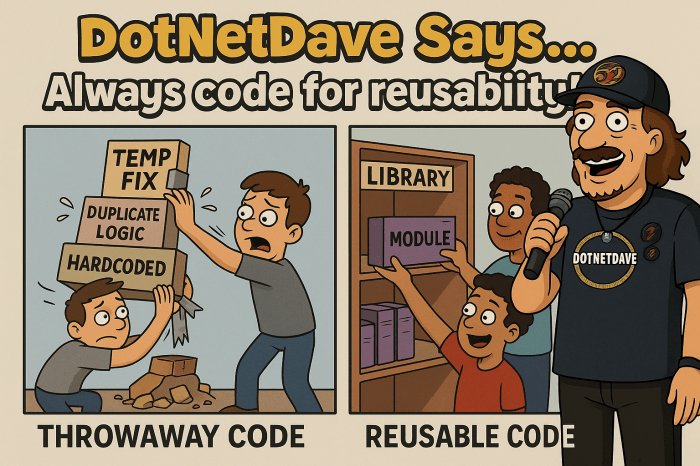
dotNetDave Says…Always Code For Reusability
The author emphasizes the importance of writing reusable and maintainable code, drawing from 25 years of experience. A project plagued by poor coding practices highlights the issues of short-term thinking and technical debt. Leaders are urged to enforce standards and prioritize quality to avoid future complications and costs associated with unmaintainable software.
New Book Release! Rock Your Code: Code & App Performance for Microsoft.NET
Today I am announcing the brand new edition of my book titled Rock Your Code: Code & App Performance for Microsoft .NET, now available on Amazon. How fast your code executes is very important for your users and back-end server processes. This is even more important for the future as more and more users, use … Continue reading New Book Release! Rock Your Code: Code & App Performance for Microsoft.NET
Maximizing Code Reuse: Strategies for Efficient Development
The article discusses the importance of maximizing code reuse in software development, emphasizing the use of separate, reusable DLLs (C# projects) for efficient code organization. The author highlights the benefits of code reuse, including easier unit testing, maintenance, sharing, and updates, ultimately leading to cost and time savings in the long term.
Code Quality: A Fundamental Feature, Not an Afterthought
The author, as a contractor, observes a worrying trend of poor code quality across projects, often overseen by senior engineers. Despite advocating for clean coding practices through teaching and writing, companies prioritize short-term gains over long-term maintainability. The author urges developers to prioritize code quality and leverage available resources for improvement.
Performance: Exception Trapping
Last year while presenting my Rock Your Code: Code and App Performance in Microsoft .NET session at a conference, one of the attendees asked me if using the When() clause is faster or not when trapping Exceptions. I found the question intriguing, so I set out to do performance testing for his question. Two Ways … Continue reading Performance: Exception Trapping

You must be logged in to post a comment.