
This is an excerpt from: Rock Your Career: Surviving the Technical Interview
At this stage of my career, I’ve worked with a lot of recruiters, good ones, mediocre ones, and far too many who clearly didn’t do their homework. After more than two decades in this industry, including time as a hiring manager and interviewer, one truth has become painfully obvious:
Transparency is not optional. It is the foundation of trust.
Let me ask you a question.
How many of you have received an email or cold call from a recruiter that looked something like this?
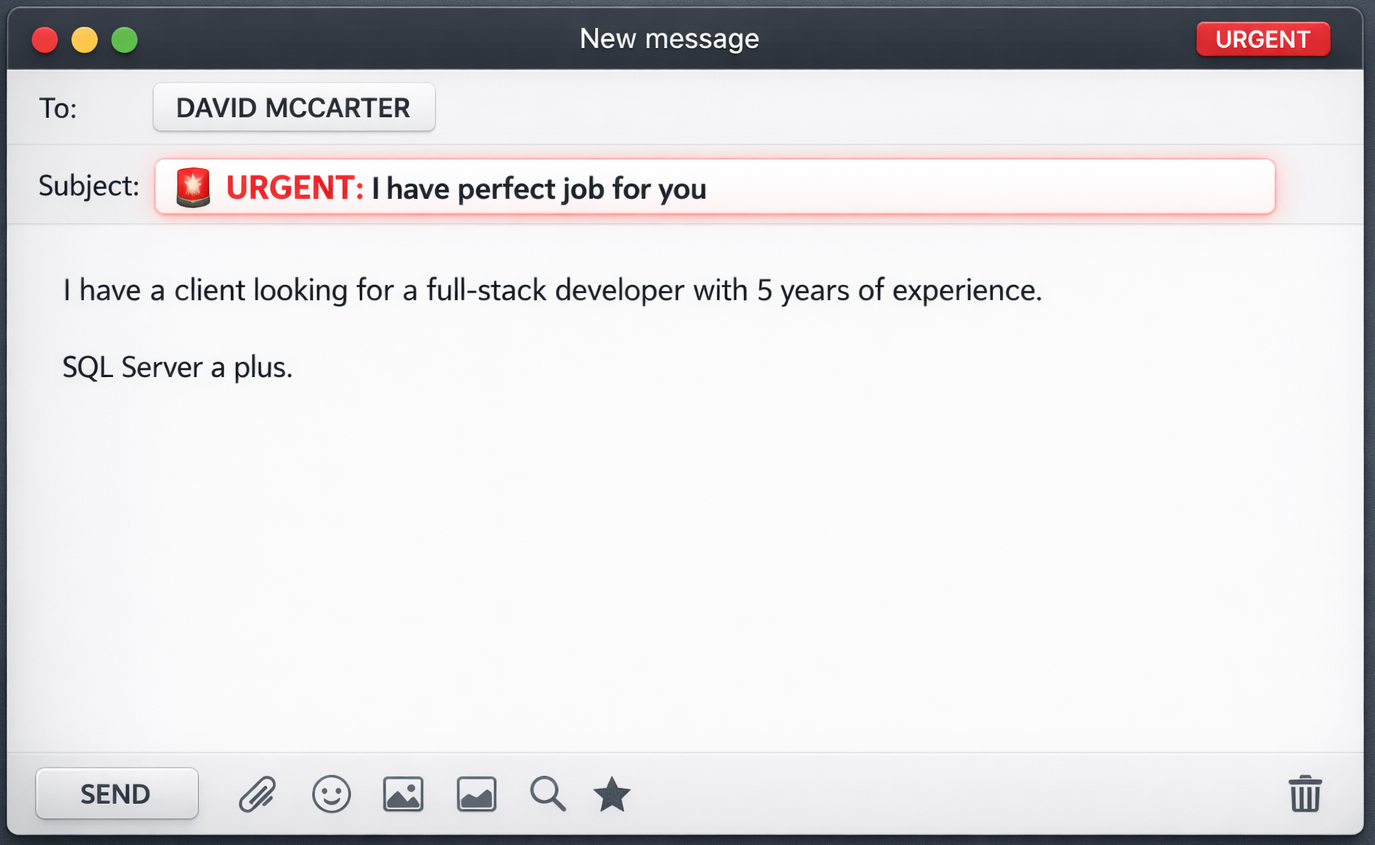
That’s it. No company name. No tech stack. No salary range. No job description.
Hardly any information, right?
The first questions that immediately come to mind are:
- Who are you?
- What company is this for?
- What technology stack are we talking about?
- Why do you think I’m a fit?
- What are you not telling me?
Yet messages like this show up in engineers’ inboxes every single day.
This is why I say in my tech interview book:
Good recruiters are transparent and willing to share details about the job position.

I understand why some recruiters withhold information. They worry candidates will bypass them and apply directly to the company. While that concern is real, what many recruiters fail to realize is this: strong candidates want recruiters to represent them, especially during salary and contract negotiations.
When I find a company or role that genuinely interests me, I often reach out to recruiters specifically to ask whether they work with that organization and to have them submit my resume on my behalf. A good recruiter adds value. I encourage you to think the same way.
Another reason vague outreach exists is speed. Many recruiters want to get you on a phone call quickly so they can control the flow of information. Whether you choose to engage under those conditions is a personal decision. In my case, I usually don’t.
Given my experience, I am fully capable of evaluating whether I’m qualified for a role. Most recruiters are not technical, and many do not fully understand the nuances of the positions they are promoting. That gap becomes obvious very quickly.
What puzzles me even more is being contacted about roles requiring five years of experience when I have more than twenty. That disconnect alone tells me the recruiter has not taken the time to understand my background—or the role they’re trying to fill.
Most of the time, I simply ignore messages like this.
If I do choose to respond, I ask for four basic pieces of information upfront:
- The company name and location
- The salary range or contract rate
- Whether the role is in-person, hybrid, or remote
- The full job description
These are not unreasonable requests. They are the bare minimum needed to determine whether a conversation is worth having.
High-quality recruiters do not send bulk emails and hope something sticks. They vet roles carefully and take time to understand your experience, goals, and constraints before presenting an opportunity. That relationship should be built intentionally, not rushed.
Unfortunately, even after multiple follow-ups, many recruiters still fail to provide this information. When that happens, I take it as a clear signal. If a recruiter cannot—or will not—share fundamental details about a job, I flag the message as spam and move on. I suggest you do the same.
Transparency matters.
Recruiters who respect your time and experience understand that. Those who don’t are telling you exactly who they are.
Summary and Actionable Takeaways
For Job Seekers:
- Do not reward vague outreach. If an email lacks basic details, treat it as a red flag.
- Ask for the essentials upfront: company, compensation range, work model, and full job description.
- Use recruiters strategically. Good recruiters can advocate for you and negotiate on your behalf.
- Trust your experience. If something feels off, it probably is.
- Flag and move on from recruiters who repeatedly dodge transparency. Your time is valuable.
For Recruiters:
- Lead with clarity. Share the company name, role details, and compensation range early.
- Respect candidates by doing your homework before reaching out.
- Understand the role you’re recruiting for, or partner closely with someone who does.
- Build relationships, not pipelines. Strong candidates choose recruiters they trust.
- Remember: transparency doesn’t weaken your position—it strengthens it.
Good recruiters don’t hide information.
They earn trust by sharing it.


Pick up any books by David McCarter by going to Amazon.com: http://bit.ly/RockYourCodeBooks
Make a one-time donation
Make a monthly donation
Make a yearly donation
Choose an amount
Or enter a custom amount
Your contribution is appreciated.
Your contribution is appreciated.
Your contribution is appreciated.
DonateDonate monthlyDonate yearlyIf you liked this article, please buy David a cup of Coffee by going here: https://www.buymeacoffee.com/dotnetdave
© The information in this article is copywritten and cannot be preproduced in any way without express permission from David McCarter.
Discover more from dotNetTips.com
Subscribe to get the latest posts sent to your email.

 dotNetTips.com