
This is an excerpt from: Rock Your Code: Coding Standards for Microsoft .NET
Most software problems aren’t caused by bad algorithms—they’re caused by code no one understands anymore.
One of the most critical—and often underestimated—responsibilities in software development is establishing and following clear, consistent naming standards. Thoughtful naming of variables, methods, classes, and other code elements is foundational to writing clean, maintainable, and professional-grade software.
Clear naming dramatically improves readability and reduces friction when working with a codebase. It helps other engineers understand your intent quickly, and just as importantly, it helps future you make sense of the code weeks, months, or even years later.
This is why I often say:
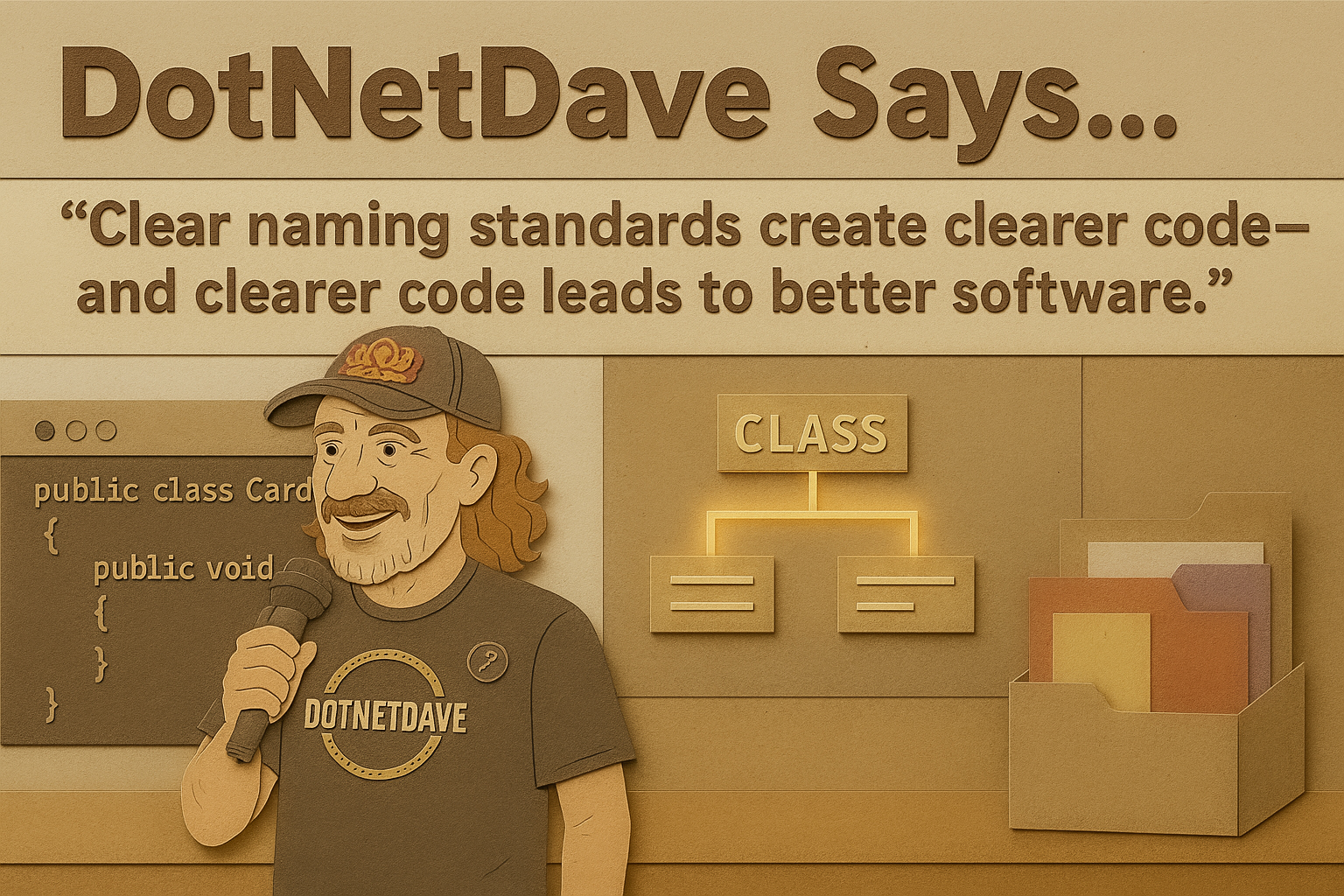
Clear naming standards create clearer code—and clearer code leads to better software.
David McCarter
While reading, maintaining, and modifying code can sometimes feel tedious or overwhelming, investing a small amount of effort upfront to apply solid naming conventions pays dividends over the life of the software. Well-named code reduces cognitive load, simplifies collaboration, and helps prevent defects caused by ambiguity or misunderstanding.
It’s important to be clear about what naming standards are—and what they are not. Naming standards are not about perfection or personal preference. They are about consistency. Even a “good enough” standard, when applied consistently, is far more valuable than no standard at all.
Microsoft’s .NET Framework has long demonstrated the value of disciplined naming conventions. When exploring the framework through GitHub repositories, object browsers, or decompilers, the clarity and uniformity of the APIs stand out. Unfortunately, as .NET has evolved—particularly in more recent years—that level of rigor has not always been carried forward consistently in third-party libraries, open-source projects, or even some internal enterprise codebases.
That is why naming standards matter now more than ever.
Establishing and enforcing clear, consistent naming conventions elevates overall code quality, shortens onboarding time for new team members, and significantly reduces long-term maintenance costs. Pairing those standards with robust XML documentation further strengthens the codebase by providing intent, context, and guidance for both developers and tooling.
More than 20 years ago, I released Rock Your Code: Coding Standards for Microsoft .NET to help teams adopt and apply proven standards effectively. Yet today, in code reviews across industries—including code originating from Microsoft itself—I routinely see naming standards ignored or inconsistently applied. XML documentation, once considered a best practice, is frequently missing altogether. This problem is even more pronounced in many open-source libraries.
With over 25 years of experience as a software engineer, I can say this with confidence: unclear naming has real and measurable consequences. When naming standards are ignored, code becomes harder to understand, features take longer to implement, bugs take longer to fix, and projects slow down. In many cases, the cost of poor naming isn’t obvious at first—but it quietly compounds with every new feature, every bug fix, and every new developer added to the team. Ultimately, these issues translate directly into higher costs and increased risk for the business.
To prevent this, I strongly recommend the following:
- Use a robust EditorConfig file to enforce naming and coding standards consistently.
- Do not commit code to source control until standards compliance has been verified through review.
- Do not commit code without meaningful comments and thorough XML documentation. Modern tools, including Copilot, can help accelerate this process—but they do not replace accountability.
These steps are straightforward and easy to adopt, especially when supported by clear guidance and established standards. Coding this way not only improves the software—it reflects positively on you as a professional and builds trust with your peers and managers.
For leaders and managers, enforcing naming standards is one of the simplest and most cost-effective ways to reduce technical debt before it becomes a crisis.
Clear naming is not a preference. It’s professionalism.
My EditorConfig settings: https://bit.ly/dotNetDaveEditorConfig

Pick up any books by David McCarter by going to Amazon.com: http://bit.ly/RockYourCodeBooks
Make a one-time donation
Make a monthly donation
Make a yearly donation
Choose an amount
Or enter a custom amount
Your contribution is appreciated.
Your contribution is appreciated.
Your contribution is appreciated.
DonateDonate monthlyDonate yearlyIf you liked this article, please buy David a cup of Coffee by going here: https://www.buymeacoffee.com/dotnetdave
© The information in this article is copywritten and cannot be preproduced in any way without express permission from David McCarter.
Discover more from dotNetTips.com
Subscribe to get the latest posts sent to your email.

 dotNetTips.com