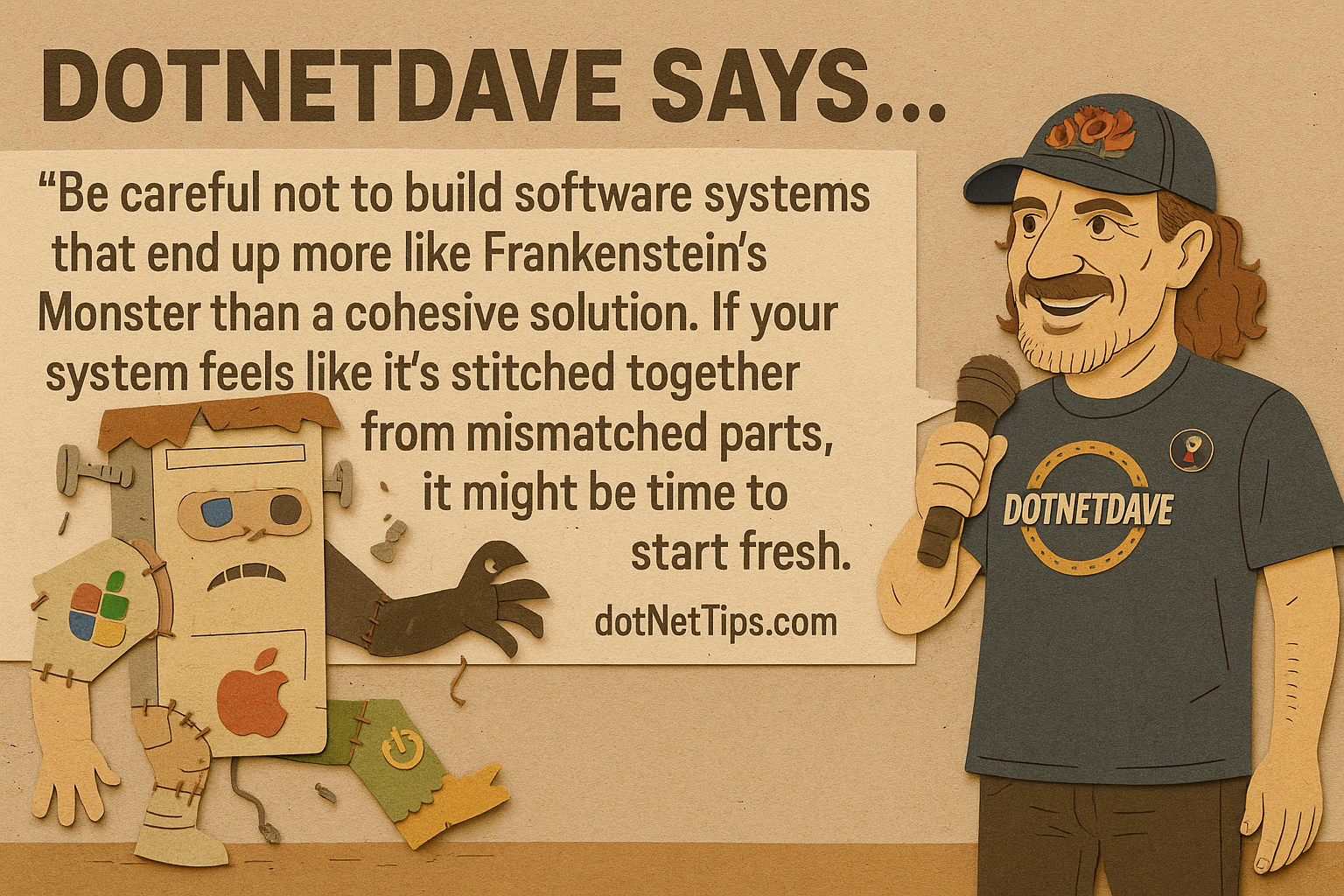
After decades in the software industry, I’ve seen what makes projects succeed—and what causes them to unravel. One of the biggest threats? Building software systems that look more like Frankenstein’s Monster than a cohesive, maintainable solution.
This is why I say:
“Be careful not to build software systems that end up more like Frankenstein’s Monster than a cohesive solution. If your system feels like it’s stitched together from mismatched parts, it might be time to start fresh.”
The Monster Metaphor: A Timeless Warning
Let’s start with a quick reminder of who Frankenstein’s Monster is. In Mary Shelley’s 1818 novel Frankenstein; or, The Modern Prometheus, the creature is assembled from mismatched body parts and brought to life through questionable science. Although the Monster is intelligent and capable of feeling, he’s rejected by society, ultimately becoming isolated, bitter, and destructive. He dies alone—burdened by regret, pain, and the consequences of his unnatural creation.
Sound familiar? This is more than a horror story—it’s a cautionary tale for software engineers.
Beware the Patchwork Project
In my 20+ years of experience, I’ve worked on both award-winning systems and projects that never made it out the door. One pattern I’ve seen repeatedly is what I call Frankenstein’s Monster Applications: systems that are stitched together with mismatched technologies, frameworks, and practices.
This doesn’t happen overnight. It starts with good intentions: “Let’s use the best tool for the job.” A sound philosophy—until it turns into an excuse for overengineering or chasing shiny new tech without considering long-term maintainability.
A Personal Origin Story
I coined the term Frankenstein’s Monster Application over 17 years ago while working in San Diego. Most of our projects were built using Microsoft technologies, but at that time, interoperability was rough. Integrating disparate frameworks added needless complexity and slowed us down. Fortunately, today’s frameworks—especially on the Microsoft stack—play much more nicely together, particularly with Azure in the mix.
But the danger hasn’t disappeared. In fact, it may have evolved.
Case Study: A Docker Disaster
At a recent contract, I encountered a classic example. The project was built entirely in .NET Core, but the team’s manager—coming from a Java background—mandated that everyone build and test code inside Docker Linux VMs.
It was a nightmare.
Each developer spent nearly a month just getting the environment set up, often needing the manager’s help. There was no documentation. If the VM image got corrupted, we had to start from scratch. Worse, many unit tests didn’t even run properly in the Linux container. As a result, productivity tanked, deadlines were missed, and quality suffered.
Despite raising my concerns, the process never changed.
A Call to Action for Teams
Before you allow your project to become a stitched-together monstrosity:
- Step back and evaluate your architecture. Is there a clear, coherent design?
- Avoid forcing tools that don’t belong. Just because something is trendy or familiar doesn’t mean it’s the right choice.
- Prototype integrations. Don’t assume technologies will work well together—test and verify.
- Stick to what your platform supports best. If you’re on Microsoft tech, strongly consider Azure. Microsoft technologies are first-class citizens there—unlike with AWS or Google Cloud.
- Know your limits. If you’re venturing into AWS or other ecosystems, hire dedicated experts. These platforms are powerful, but they require experience to configure correctly and cohesively.
Final Thoughts
Yes, use the best technology for the job—but know when “best” becomes “burdensome.” A good application is greater than the sum of its parts. Frankenstein’s Monster wasn’t—and neither should your software be.
If you’ve ever worked on a Frankenstein’s Monster application, I would love to hear from you.

Pick up any books by David McCarter by going to Amazon.com: http://bit.ly/RockYourCodeBooks
Make a one-time donation
Make a monthly donation
Make a yearly donation
Choose an amount
Or enter a custom amount
Your contribution is appreciated.
Your contribution is appreciated.
Your contribution is appreciated.
DonateDonate monthlyDonate yearlyIf you liked this article, please buy David a cup of Coffee by going here: https://www.buymeacoffee.com/dotnetdave
© The information in this article is copywritten and cannot be preproduced in any way without express permission from David McCarter.
Discover more from dotNetTips.com
Subscribe to get the latest posts sent to your email.

 dotNetTips.com
One thought on “dotNetDave Says… Don’t Build Frankenstein’s Monster Applications!”