
Spargine is a set of open-source assemblies and NuGet packages for .NET 8, developed and maintained by me since the release of .NET 2. These assemblies are integral to my projects and are currently in production at my company. You can access the source code and NuGet packages through the following links:
- GitHub: Spargine Releases
- NuGet: dotNetDaveNuGet
The UlidGenerator class in the DotNetTips.Spargine.8.Core assembly provides methods for generating ULIDs (Universally Unique Lexicographically Sortable Identifiers).
What is a ULID?
A ULID is a unique identifier introduced as an alternative to UUIDs (Universally Unique Identifiers). It combines randomness with lexicographical (alphabetical) sorting, offering a balance between human readability, ease of use, and performance.
Structure of a ULID:
- 48-bit Timestamp: Represents milliseconds since the Unix epoch (1970-01-01T00:00:00Z), ensuring that ULIDs are time-sortable.
- 80-bit Randomness: A randomly generated component that provides a high level of uniqueness.
A ULID is typically represented as a 26-character alphanumeric string using base32 encoding, making it more compact than a UUID.
Example of a ULID: 01ARZ3NDEKTSV4RRFFQ69G5FAV
Key Benefits of ULIDs:
- Time-based Sorting: Easily sortable by creation time due to the timestamp component.
- Compact and Readable: Shorter and more human-friendly than UUIDs.
- Uniqueness: The 80-bit randomness provides a high level of entropy, minimizing the risk of collisions.
- Distributed System Friendly: Well-suited for distributed environments, preserving both uniqueness and order.
- Temporal Information: The embedded timestamp is useful for tracking event sequences.
- Cross-language Support: ULIDs are implemented across multiple programming languages.
These features make ULIDs an excellent alternative to UUIDs in systems requiring time-based sorting with guaranteed uniqueness.
Methods
To facilitate the generation and use of ULIDs, the UlidGenerator class includes the following methods:
- GenerateUlid(): Generates a new ULID.
- GenerateMultipleUlids(): Generates multiple ULIDs based on the specified count.
Performance
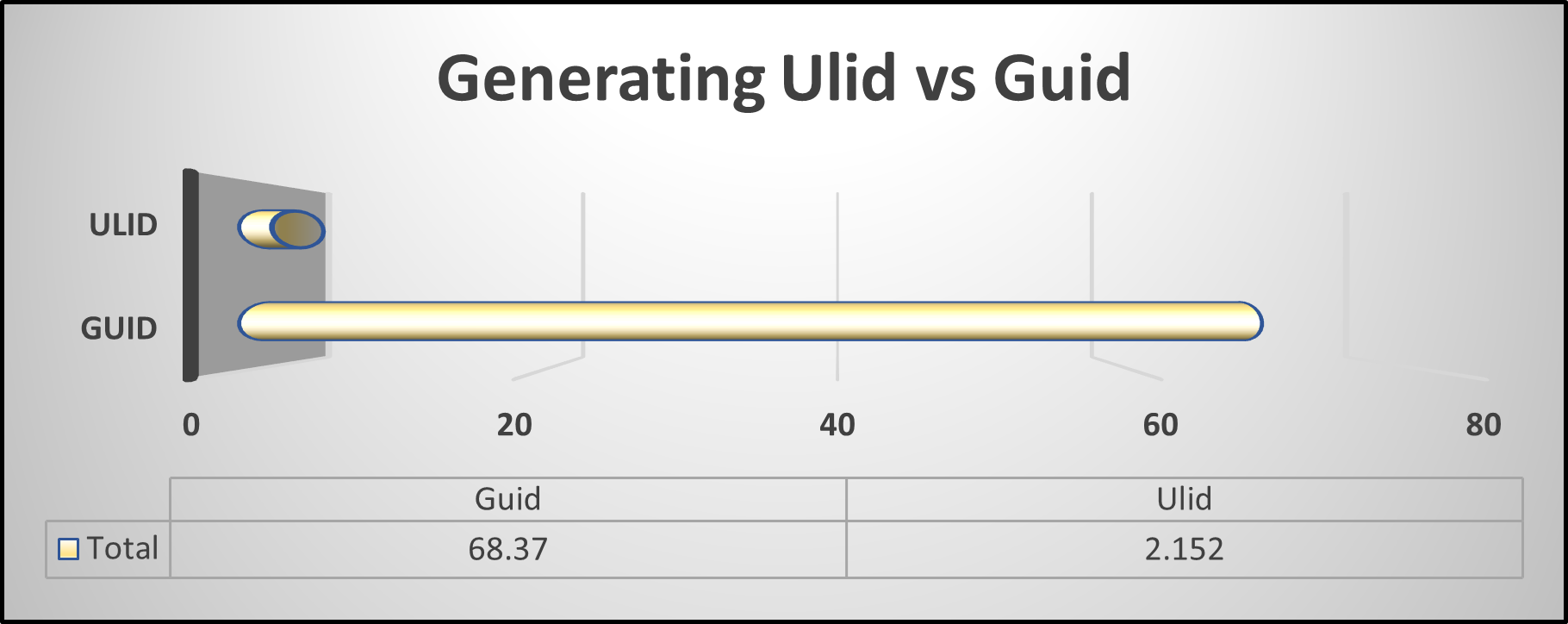
As shown in benchmark results, generating a ULID is 32 times faster than creating a GUID, making ULIDs a highly efficient choice for applications requiring fast and reliable unique identifiers.
Summary
I am confident that these enhanced methods in Spargine will greatly benefit your projects by improving performance and reliability. Detailed benchmark results are available on GitHub. The success of open-source projects like Spargine depends significantly on community involvement. If you find these updates useful or have ideas for further improvements, I encourage you to contribute. Whether by submitting a pull request, reporting issues, or suggesting new features, your input is invaluable.
Together, we can continue to make Spargine a powerful and essential tool for the .NET community. Your feedback and suggestions are highly appreciated, so please share them in the comments section.
If you are interested in contributing to this project or have any questions, feel free to contact me via email at dotnetdave@live.com. Your support and collaboration are greatly appreciated!
Thank you for your support, and happy coding!
Pick up any books by David McCarter by going to Amazon.com: http://bit.ly/RockYourCodeBooks
Make a one-time donation
Make a monthly donation
Make a yearly donation
Choose an amount
Or enter a custom amount
Your contribution is appreciated.
Your contribution is appreciated.
Your contribution is appreciated.
DonateDonate monthlyDonate yearlyIf you liked this article, please buy David a cup of Coffee by going here: https://www.buymeacoffee.com/dotnetdave
© The information in this article is copywritten and cannot be preproduced in any way without express permission from David McCarter.
Discover more from dotNetTips.com
Subscribe to get the latest posts sent to your email.

 dotNetTips.com