
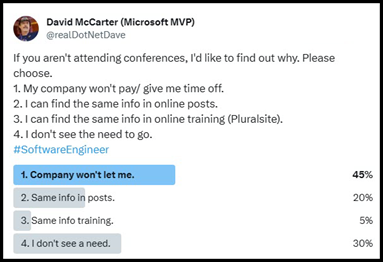
Now that COVID is being effectively managed and in-person conferences are making a comeback, there’s a noticeable trend of low attendance. While I personally understand the value of conferences, I sought to uncover why engineers seem to be reluctant to participate. A Twitter poll revealed that the primary reason, as evident in the responses, is that their employers restrict attendance at conferences.
In this article, I aim to emphasize the significance of attending and actively engaging in conferences. My goal is to enlighten engineers, particularly the younger generation, about the benefits of participating and, concurrently, to encourage companies to recognize the importance of allocating budgets and providing time off for their engineers to attend these events.
Embracing Growth Through Conferences: A Software Engineer’s Journey
I’ve been an avid conference attendee since my first year as a professional software engineer, starting with the former Visual Basic Insiders Summit in San Francisco. In those early days, when the Internet was still relatively new, conferences, books, and interactions with fellow engineers were our primary sources of learning.
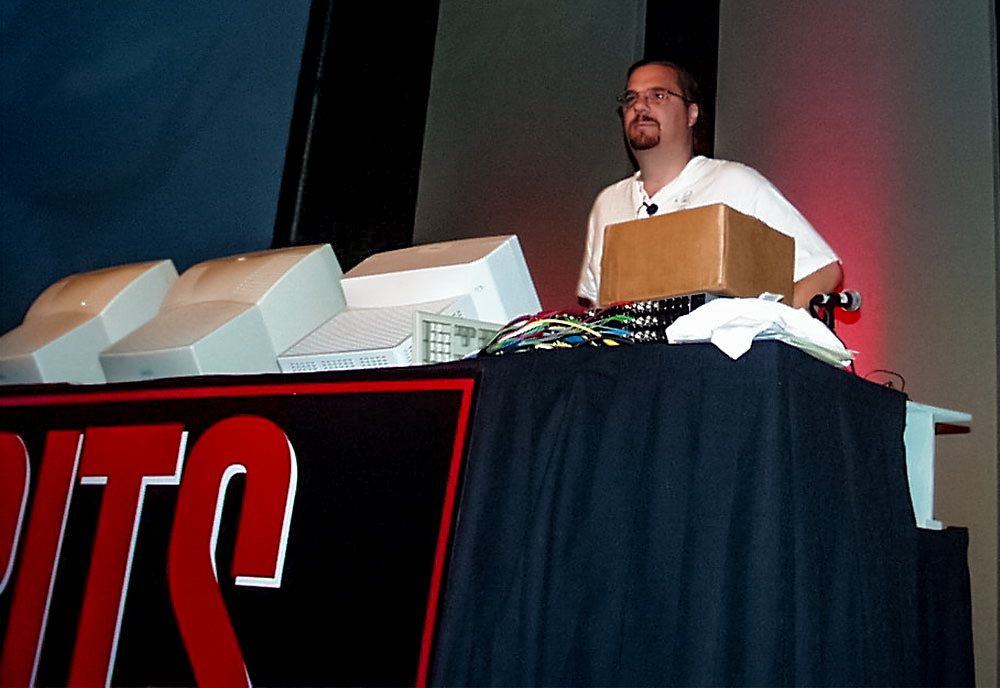
Back when I first began attending conferences, cell phones were not yet a common accessory! Here’s a photo capturing a moment from my speaking engagement at the VBITS conference.
The importance of attending conferences became abundantly clear to me at that initial event. A keynote speaker’s words still resonate with me today – conferences expose you to diverse approaches in application development and provide insights into the latest products and services offered by sponsors.
For me, the true value of conferences lies in networking – engaging in conversations with people. Whether I’m a speaker or an attendee, I relish connecting with others, addressing their queries, and understanding the challenges they face in their roles. Conversations with fellow speakers contribute significantly to my knowledge base.
I make a point to attend all events, including attendee parties, to continue building connections with both speakers and attendees. I advocate stepping out of one’s comfort zone by approaching unfamiliar faces and initiating conversations. While this may be daunting for some engineers, pushing through and being outgoing ultimately enhances your development skills.
However, I admit that returning home from a conference leaves me with a sense of melancholy. Spending nearly a week surrounded by brilliant speakers and attendees creates a connection I deeply enjoy. The transition back to a daily routine without the constant interaction with such intelligent minds can be a bit disheartening. Yet, the experiences gained and the knowledge acquired make these conferences an invaluable investment in personal and professional growth.
Exploring Conference Perspectives: Insights from Diverse Voices
I’ve previously discussed my reasons for attending conferences and engaging in conversations with various speakers. However, for this article, I sought additional perspectives by reaching out to a diverse group of individuals via Twitter. Below, you’ll find the insights and opinions shared by respondents.
- Barret Blake: Presenting. Running. Volunteering. Learning about things I would not normally spend the time to learn about. My first exposure to many topics over the years was from attending conference sessions. I rarely attend sessions for things I already know about.
- Beka Modebadze: Learn what others are working on, network – meet similar-minded folks, and get inspired.
- Christopher Johnson: I usually go because I’m either presenting, want to meet people, or I want more free stickers and socks. I do go to some presentations, but mostly to learn how to make mine better.
- Howard Fore: I go to get exposed to other ways of attacking challenges than what I’m used to.
- Jim Wilcox: People are the real value in every situation, and the connections themselves can’t be made through ChatGPT. Then, you get to learn what terms people in the real world are using in solutions. Understanding such terms often beneficially impacts queries & prompts.
- Karen Payne: Meeting with people I know online. Sharing ideas is much better in person.
- Michael Hagesfeld: I love the chance to see things from a different angle and get confirmation that I’m doing things right.
- Vahid Farahmandian: The sense of participation in the community. Sharing ideas.
- Xavier Abelaira Rueda: Ideas, networking, but above all inspiration.
Moving forward, let’s delve into the inquiries I posed in the Twitter poll.
The Decline of Conference Sponsorship in Engineering: A Reflection on Industry Trends
In the early stages of my career, it was commonplace for companies to sponsor engineers to attend multiple conferences annually. In fact, some of my employment contracts explicitly mandated that I be sent to at least two conferences each year.
Fast forward to 2023, and the landscape has shifted. Many companies no longer cover the costs or permit their engineers to participate in conferences or other training opportunities. Surprisingly, even a major player like Verizon, boasting a revenue of 136.8 billion in 2022, does not allocate resources for conference attendance. Perhaps this explains the suboptimal code quality I’ve observed among Verizon developers, marked by poor architecture and numerous code violations.
The primary reason behind this trend seems to be a cost-saving mentality. Companies may underestimate the true value of attending conferences, potentially assuming that online resources suffice. While alternative methods like training platforms such as PluralSight are beneficial, they fall short of replicating the in-person experience of a conference.
One prevalent concern is that companies fear investing in their developers’ continuous education because they worry about them acquiring new skills and eventually leaving the company. However, this perspective is shortsighted. My survey indicates that developers typically stay in a position for 2 to 5 years, regardless of educational investments. Companies fail to recognize that these newfound skills can enhance the quality of the software they produce, leading to increased customer satisfaction.
This reluctance to invest in ongoing education and conferences may be a major factor behind the technological lag observed in numerous companies. Developers become stagnant, hindering progress and innovation. I experienced this firsthand at a previous workplace where applications and services seemed a decade behind the technological curve. Their resistance to embracing cloud features resulted in sluggish backend services and a three-year project just to perform a basic “lift and shift” to virtual machines.
When considering potential employment opportunities, it becomes crucial to inquire about a company’s stance on sponsoring conferences and supporting ongoing education. A company willing to invest in these aspects demonstrates a commitment to the professional growth and effectiveness of its engineers and, consequently, the quality of its applications.
Unlocking Insights Beyond the Podium: A Deeper Dive into Conference Content
Yes, you can find similar information in blog posts. I’ve written numerous articles covering the content I present at conferences. For instance, there’s a three-part article series titled “Everything That Every .Net Developer Needs to Know About Disposable Types.” However, it’s important to note that when I speak on a topic, I often share additional insights that may differ from what’s written.
Furthermore, it’s not feasible to approach speakers during or after their sessions for further discussion. The conference setting provides a unique opportunity for you to engage directly with the expert, asking specific questions to enhance your understanding of the apps and services you’re working on.
When I’m a speaker at a conference, I consider it my responsibility to be accessible for attendee queries. The ease with which attendees ask questions can vary depending on the conference’s location, often influenced by cultural factors. Regardless, if you have questions, seize the chance to approach a speaker and inquire! There’s nothing to lose, and it can greatly enrich your conference experience.
Unlocking In-Depth Learning: The Power of Training Courses and Workshops
Just as with blog posts, training courses typically involve one-way communication. However, training courses provide a more comprehensive learning experience compared to blog posts or conference sessions. In conferences that offer workshops, often at an additional cost, you have the opportunity to dedicate a full day or half-day to receiving hands-on training from an expert in the field.
This presents an ideal chance to seek expert advice and address specific questions related to your work. For instance, I conducted a workshop on globalization at BuildStuff this year, where I was able to assist attendees with the challenges they were encountering in their professional settings. In my view, these workshops serve as invaluable resources for practical, tailored learning.
Unlocking the Potential: The Value of Developer Conferences in Career Growth
I believe that many younger developers share this sentiment. Unfortunately, numerous companies restrict their developers from attending conferences, depriving them of the exposure I had when I was a beginner. If you find yourself in this situation, I hope I provided you with compelling reasons to consider attending a conference.
If your company doesn’t permit conference attendance, I recommend exploring community-run conferences nearby, such as Code Camp. These events are typically free or have minimal costs, and they often take place on weekends, eliminating the need to request time off. I particularly appreciate community-run conferences because they are organized by engineers, just like you and me.
By attending a conference once and following the advice in this article, I am confident that you’ll be eager to participate in more such events.
In Conclusion
I trust that I’ve provided you with ample reasons to recognize the significance of attending in-person conferences for your growth in the tech industry. When you participate in these events, consider the following:
- Engage with speakers by asking questions, providing feedback, and expressing your appreciation. Speakers invest considerable effort in delivering valuable information at conferences.
- Actively seek opportunities to meet new people and initiate discussions. The insights you gain from others can be immensely valuable. I’ve personally benefited greatly from such interactions.
- Attend networking events designed to connect with both speakers and fellow attendees. These occasions are enjoyable, creating a positive atmosphere for meaningful connections.
I look forward to potentially encountering you at a conference in the future. Please feel free to share your thoughts and insights in the comments below. Your feedback is always valued and appreciated.
Pick up any books by David McCarter by going to Amazon.com: http://bit.ly/RockYourCodeBooks
Make a one-time donation
Make a monthly donation
Make a yearly donation
Choose an amount
Or enter a custom amount
Your contribution is appreciated.
Your contribution is appreciated.
Your contribution is appreciated.
DonateDonate monthlyDonate yearlyIf you liked this article, please buy David a cup of Coffee by going here: https://www.buymeacoffee.com/dotnetdave
© The information in this article is copywritten and cannot be preproduced in any way without express permission from David McCarter.
Discover more from dotNetTips.com
Subscribe to get the latest posts sent to your email.

 dotNetTips.com
One thought on “Beyond the Screen: The Power and Perks of In-Person Tech Conferences”