Recently, while cleaning out my attic, I stumbled upon a treasure trove of nostalgia from the ’90s. Among the items in a dusty old box was a copy of my very first article, published in a prestigious programming magazine. As someone who has dedicated over 20 years to the craft of software development, I’ve amassed a wealth of experiences and anecdotes. With plenty of time on my hands due to the ongoing pandemic, I’ve decided to embark on a writing journey, sharing these stories in a series titled “Geekstory.” My ultimate goal is to inspire fellow software engineers with tales from my career and provide them with valuable insights along the way.
For more career advice, please pick up a copy of my book “Rock Your Career: Surviving the Technical Interview” available on Amazon.com.
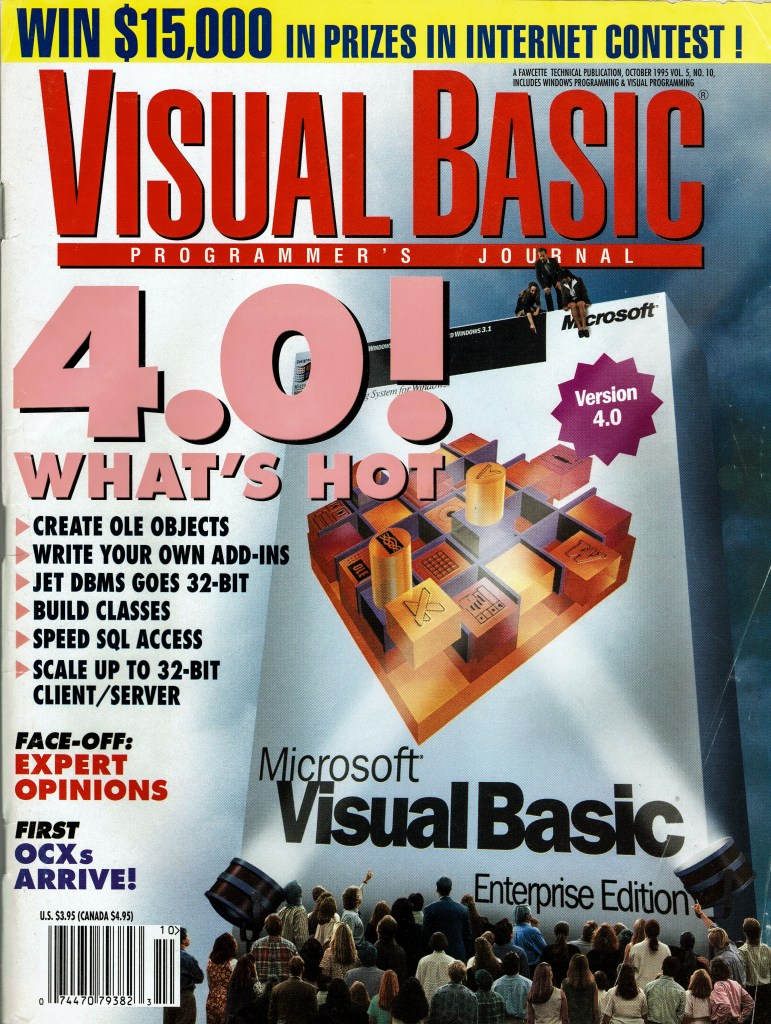
Visual Basic Programmer’s Journal
In 1994, I made the transition to becoming a full-time software engineer. It was around that time, either in 1994 or 1995, that I attended my first Visual Basic Insiders Summit (VBITS) in San Francisco. This annual conference, organized by Fawcette Technical Publications (FTP) founded by Jim Fawcette, was a significant event in the Visual Basic community. It was during one of these initial conferences that I had the fortunate encounter with Robert Scoble, who was working for FTP at the time. I can’t recall the exact circumstances, but Robert took an interest in me and played a pivotal role in my journey as a writer for the magazine.
I had the privilege of contributing articles to the publication on multiple occasions and even had the opportunity to speak at VBITS, with my first session being a paid engagement! Additionally, Robert extended an invitation for me to join the annual speaker’s bus tour, an exciting adventure that took us to renowned destinations in California like Yosemite, Napa Valley, and Silicon Valley. I eagerly anticipated VBITS each year, but the bus tour held a special place in my heart. Robert truly spoiled us, and now, whenever I attend conferences as a speaker, I find myself longing for a similar experience. It seems that nowadays, only conferences in other countries offer such extraordinary perks.
I’m not sure if Robert is aware of the impact he had on my career, serving as a catalyst for my foray into writing. For that reason, I will forever be grateful to him. I suspect that Robert may have also played a role in convincing CompuServe to appoint me as a forum moderator for the magazine, although I’m not entirely certain.
Reflecting on those formative years, I’m reminded of the people like Robert Scoble who played a significant role in shaping my professional trajectory. Their support and guidance helped propel me forward, and I cherish those memories as I continue to evolve in my software engineering career.
The Article
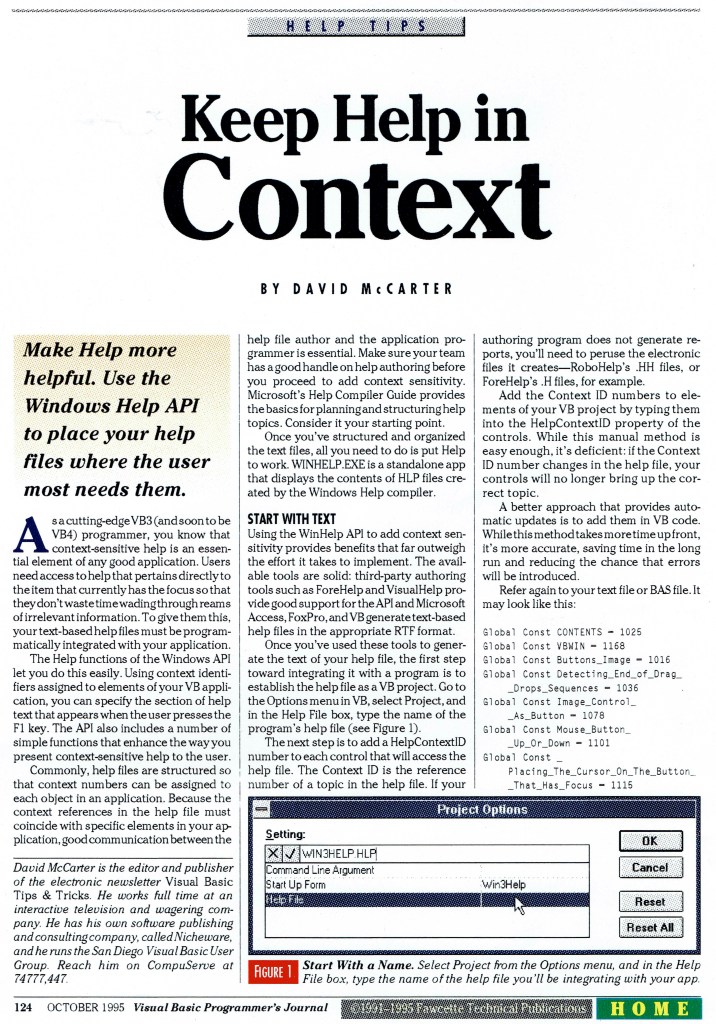
The first article I wrote for this magazine was about the significance of Windows help files titled “Keeping Help In Context.” It emphasized the importance of comprehensive help documentation for applications and provided guidance on linking the F1 key to relevant help pages within the file. Even back in 1995, I recognized the value of good documentation, especially for the benefit of users.
However, I have noticed that the use of F1 for help has diminished in recent times. Many applications, such as OneNote, Word, and others, no longer direct users to the specific help page they need, but rather to a general top-level help page. As a user, this frustrates me because it means I have to go through the extra effort of finding the information I’m seeking. Unfortunately, this may lead users to give up on seeking help altogether, as I often do. Additionally, I can’t recall the last time I encountered a traditional Windows help file, as companies now tend to rely on websites for documentation.
In my opinion, a project should not be considered complete until the documentation, including help pages, is finalized. Therefore, if you are developing an application, API, or any product that requires documentation, it is your team’s responsibility to ensure that the documentation is comprehensive and readily available prior to release.
For instance, when it comes to Microsoft .NET, I find that most of the help pages on docs.microsoft.com are unhelpful. They lack sufficient descriptions of types and methods, and the examples provided are often not practical or applicable to real-world scenarios. Consequently, I consistently give these pages a thumbs-down rating and provide suggestions for improvement, as advised by the Project Managers of the documentation team during the MVP Summit at Microsoft. They have assured us that they actively consider all suggestions for enhancements.
Networking, Networking, Networking
This article isn’t about boasting about my first magazine article, which I wrote only 1 ½ years after I started programming. Instead, I want to focus on the power of networking at every event you attend. As someone who has been advocating for software engineers to network for years, I even incorporated this topic into my career-focused sessions. Initially, I used to urge developers to network at the beginning of each session, but unfortunately, that approach didn’t yield significant results.
During my workshop on technical interviewing, which I taught at a conference in Philadelphia, I decided to take a different approach. Before lunch, I challenged each attendee to step out of their comfort zone and strike up conversations with someone they didn’t know during the lunch break. To my surprise, when I returned from upstairs after shutting things down for lunch, I found all my attendees gathered around a table, engaging in conversations with one another. They did exactly what I had advised them not to do, and I made sure to address this after lunch. As for myself, during that lunch break, I approached a table full of unfamiliar faces and initiated a conversation. I discovered that leading by example was far more effective than simply telling people what to do. In fact, I often find that I gain more value from conferences through networking rather than attending sessions. This was also true when I ran a user group for 20 years; I frequently gained insights and ideas during post-meeting social gatherings.
Remember the bus tour I mentioned earlier when I attended the VBITS conferences? It was during this tour that I had the opportunity to meet and get to know many prominent figures in our field, such as Carl Franklin from .NET Rocks and Rockford Lhotka, the CEO at Magenic and creator of CSLA .NET. I vividly recall sitting next to Rocky during one leg of the bus tour and getting to know him. Although I initially felt intimidated by these speakers, I found that connecting with them became easier during dinners, perhaps thanks to a glass of wine or two.
At one of these conferences, I even had the chance to meet and befriend Daniel Appleman, whom I greatly admired at the time. He was an expert on using Windows API calls from Visual Basic and had authored the top book on the subject, a book I always kept on my desk. It remains one of those books I will never discard. Back in 1999, Dan decided to start a new book publishing company with one of his friends. During VBITS, I remember him approaching me, sharing the news about the company, and expressing his desire for me to write a book for them. Consequently, I became one of the very first authors for Apress.
Summary
Now, I understand that striking up a conversation can be quite challenging for many developers, myself included. Believe it or not, I am a self-diagnosed introvert, and I openly acknowledge it. I struggle with this aspect constantly, even to this day. However, the drive to overcome my introversion stemmed from the realization, as early as 1994, that someday I would need to communicate effectively and speak in front of others. It turns out my intuition was correct. Overcoming my introversion has been the most significant factor in advancing my career.
If you are new to public speaking or find it challenging to initiate conversations, I encourage you to persevere until it becomes more comfortable. Speaking from personal experience, I no longer feel nervous when addressing audiences at events. Effective communication and networking are essential skills for aspiring professional software engineers. The stronger your proficiency in these areas, the more successful your career will be, and the easier it will be to secure your dream job. If I could overcome these hurdles, I believe you can too!
I hope this article serves as a helpful and encouraging resource for you. If you have any comments or questions, please feel free to share them below. For more career advice, please pick up a copy of my book “Rock Your Career: Surviving the Technical Interview” available on Amazon.com.
For more information about the power of networking, I encourage you to watch my session titled Rock Your Career: How 25 Years of Speaking Has Helped My Career and More!
Pick up any books by David McCarter by going to Amazon.com: http://bit.ly/RockYourCodeBooks
Make a one-time donation
Make a monthly donation
Make a yearly donation
Choose an amount
Or enter a custom amount
Your contribution is appreciated.
Your contribution is appreciated.
Your contribution is appreciated.
DonateDonate monthlyDonate yearlyIf you liked this article, please buy David a cup of Coffee by going here: https://www.buymeacoffee.com/dotnetdave
© The information in this article is copywritten and cannot be preproduced in any way without express permission from David McCarter.
Discover more from dotNetTips.com
Subscribe to get the latest posts sent to your email.

 dotNetTips.com